Bioengineering Guide

Bioengineering methods for erosion and shallow slope stability

Bioengineering combines vegetation with engineered elements to control erosion and shallow instability. This guide explains the individual techniques, where each suits a site, the design and establishment requirements and the limits of a vegetation-based approach.

Start here

Vegetation manages the surface, not deep instability

Bioengineering is effective against surface erosion and shallow soil movement. Deeper failure surfaces still require structural or drainage solutions.

We assess the depth and mechanism of the instability first. Where movement is confined to the root zone and surface water is the driver, vegetation-based systems can be durable, cost-effective and environmentally preferable. Where a deeper failure surface, high flow velocity or a critical asset is involved, bioengineering is used as surface protection alongside an engineered solution rather than instead of one.

  1. 01Depth of movementConfirm the instability is shallow before relying on vegetation.
  2. 02Water regimeFlow velocity, saturation and seepage often govern the treatment.
  3. 03Soil chemistryDispersive, saline or acidic soils need amendment and species care.
  4. 04Climate & seasonEstablishment timing strongly affects success in Queensland conditions.
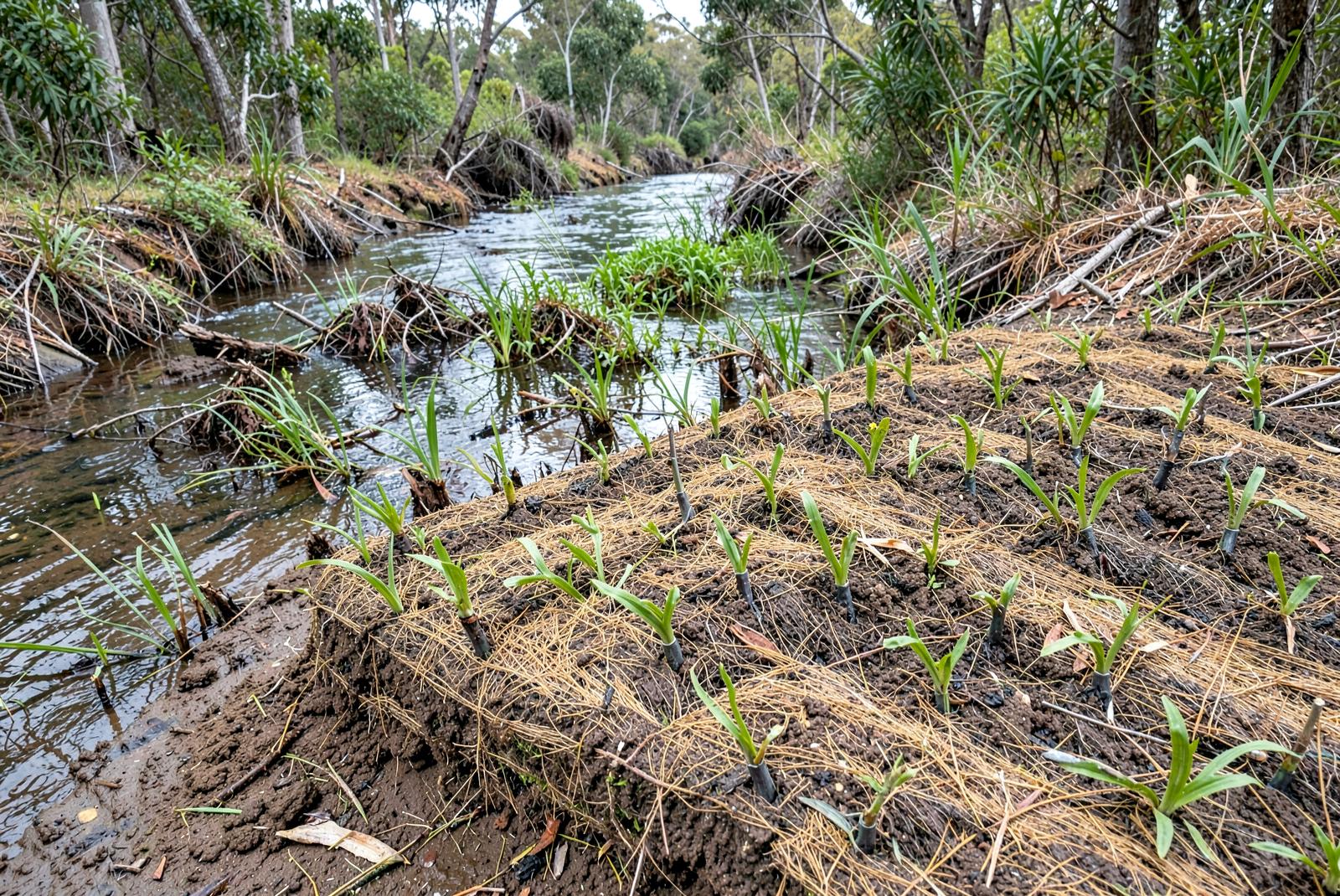
Coir erosion control matting pinned over a freshly planted creek batter with native tubestock establishing

Comparison

Technique-by-technique — at a glance

An overview only. Every entry below is described cautiously and is not an engineering limit; suitability is always confirmed against site-specific data.

Comparison of techniques, typical applications and key limitations
TechniquesBest suited toKey consideration
Erosion Control Matting & BlanketsFreshly graded batters, disturbed ground and construction-phase surface protection.Product selected for slope angle, expected flow and required design life; anchorage and edge keying detailed.
Vegetated ReinforcementSteepened batters and reinforced soil faces where a green finish is required.Reinforcement design plus growing medium depth, irrigation during establishment and species root behaviour.
Live Plantings & Brush LayeringStream banks, gully repairs and shallow slips in accessible, moist environments.Species must root readily from cuttings; layout, depth and season are critical to strike rates.
Bank & Channel ProtectionEroding creek and drain banks, and outlets where flow velocity concentrates.Toe protection is usually the controlling element; velocity, flow depth and scour depth govern design.
Soil & Vegetation SystemsAny bioengineering works, and rehabilitation over dispersive, saline or nutrient-poor soils.Testing of subsoil chemistry and dispersion informs amendment, medium depth and species choice.
Sustainable Drainage & Erosion SolutionsConcentrated runoff, roof and pavement discharge onto slopes, and post-construction site drainage.Designed to intercept and slow flow before it reaches the erodible face; outlets detailed to prevent scour.
Establishment & MaintenanceEvery bioengineering project — it is a design element, not an optional extra.Defined duration, responsibilities, inspection triggers and repair method for failed areas.

Techniques

Technique-by-technique

Species selection, planting season and establishment period are decisive in Queensland conditions and are set with the local climate and soil profile in mind.

Technique 01

Erosion Control Matting & Blankets

Biodegradable or long-term synthetic mats that hold soil and seed in place while vegetation establishes.

Best suited to / typical applications

Freshly graded batters, disturbed ground and construction-phase surface protection.

Design & construction considerations

Product selected for slope angle, expected flow and required design life; anchorage and edge keying detailed.

Limitations, risks & verification

Provides no deep stability; poor pinning or unkeyed edges lead to lifting and undermining.

Discuss this option

Technique 02

Vegetated Reinforcement

Combined geosynthetic reinforcement and root-zone vegetation for durable surface stability on steep faces.

Best suited to / typical applications

Steepened batters and reinforced soil faces where a green finish is required.

Design & construction considerations

Reinforcement design plus growing medium depth, irrigation during establishment and species root behaviour.

Limitations, risks & verification

Establishment period is the vulnerable window; needs realistic maintenance commitment.

Discuss this option

Technique 03

Live Plantings & Brush Layering

Live cuttings, stakes and layered brush placed within fill to reinforce the near-surface soil as roots develop.

Best suited to / typical applications

Stream banks, gully repairs and shallow slips in accessible, moist environments.

Design & construction considerations

Species must root readily from cuttings; layout, depth and season are critical to strike rates.

Limitations, risks & verification

Slow to reach full effect and dependent on suitable species availability and moisture.

Discuss this option

Technique 04

Bank & Channel Protection

Combined vegetation, matting, rock toe and structural edge protection for watercourse banks.

Best suited to / typical applications

Eroding creek and drain banks, and outlets where flow velocity concentrates.

Design & construction considerations

Toe protection is usually the controlling element; velocity, flow depth and scour depth govern design.

Limitations, risks & verification

High-velocity or heavily scoured sections may need hard protection; approvals may apply near waterways.

Discuss this option

Technique 05

Soil & Vegetation Systems

Topsoil, growing medium, amendment and species selection matched to the underlying soil profile.

Best suited to / typical applications

Any bioengineering works, and rehabilitation over dispersive, saline or nutrient-poor soils.

Design & construction considerations

Testing of subsoil chemistry and dispersion informs amendment, medium depth and species choice.

Limitations, risks & verification

Thin or unsuitable growing medium is the most common reason vegetation fails to establish.

Discuss this option

Technique 06

Sustainable Drainage & Erosion Solutions

Vegetated swales, level spreaders, check structures and flow-control measures that reduce erosion at source.

Best suited to / typical applications

Concentrated runoff, roof and pavement discharge onto slopes, and post-construction site drainage.

Design & construction considerations

Designed to intercept and slow flow before it reaches the erodible face; outlets detailed to prevent scour.

Limitations, risks & verification

Requires ongoing maintenance; capacity can be exceeded in intense storm events.

Discuss this option

Technique 07

Establishment & Maintenance

The watering, weed control, repair and monitoring programme through the establishment period.

Best suited to / typical applications

Every bioengineering project — it is a design element, not an optional extra.

Design & construction considerations

Defined duration, responsibilities, inspection triggers and repair method for failed areas.

Limitations, risks & verification

Without a maintenance commitment, vegetation-based solutions should not be relied on.

Discuss this option

Selection considerations

What usually decides the approach

These factors tend to narrow the options faster than any single test result. Every recommendation remains site-specific and subject to the available data.

  • Depth of movementConfirm the instability is shallow before relying on vegetation.
  • Water regimeFlow velocity, saturation and seepage often govern the treatment.
  • Soil chemistryDispersive, saline or acidic soils need amendment and species care.
  • Climate & seasonEstablishment timing strongly affects success in Queensland conditions.
  • MaintenanceAgree who maintains the works and for how long, at design stage.

Method

How the work runs

Scope is adjusted to the project, the risk and the information already available.

  1. 01AssessDetermine erosion and instability mechanisms, depth and water drivers.
  2. 02SelectMatch techniques and species to slope, soil, flow and access.
  3. 03DesignDetail treatments, drainage, anchorage and establishment requirements.
  4. 04EstablishMonitor through establishment and repair where cover fails.

Typical deliverables

  • Erosion and shallow stability assessment
  • Treatment plan with techniques, layout and details
  • Species, growing medium and amendment recommendations
  • Establishment, monitoring and maintenance requirements

Eroding batter or creek bank to stabilise?

Send photographs, the slope geometry and any drainage information. We will advise whether a vegetated approach is appropriate on its own or as part of an engineered solution.