Excavation systems

Support systems in detail

Start here

  1. 01Adjacent assetsProximity of buildings, roads and services usually sets the movement limits.
  2. 02Available landNails and anchors extend behind the face; battering needs room in front of it.
  3. 03GroundwaterWater below excavation level often decides between wall types.
  4. 04Design lifeTemporary and permanent works have very different durability requirements.
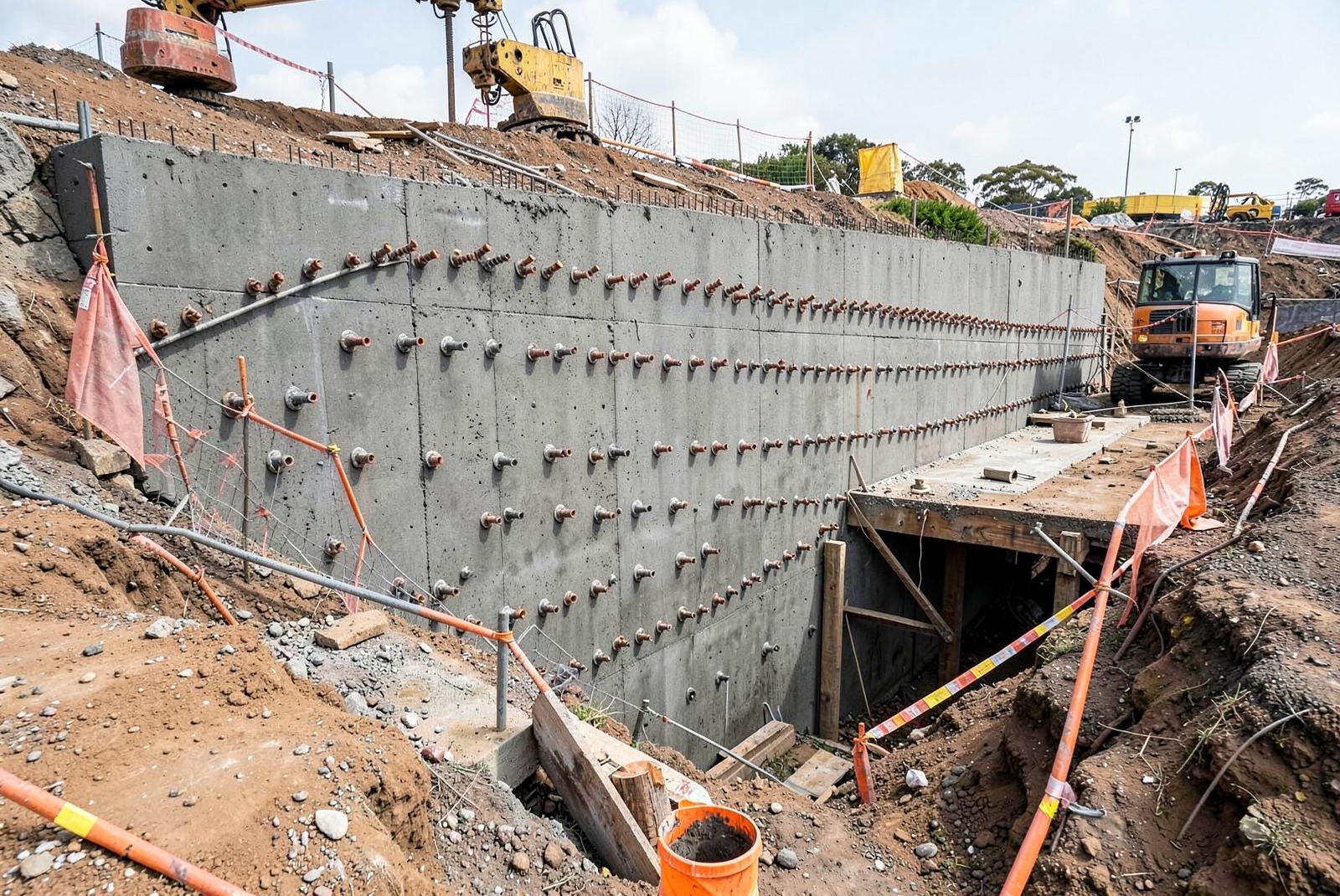
Shotcrete soil nail wall supporting a deep basement excavation

Comparison

Excavation support systems, system by system — at a glance

An overview only. Every entry below is described cautiously and is not an engineering limit; suitability is always confirmed against site-specific data.

Comparison of systems in detail, typical applications and key limitations
Systems in detailBest suited toKey consideration
Soil NailsCut faces, steep batters and top-down excavation in soils and weathered rock that stand briefly unsupported.Bond length, spacing, inclination, facing (shotcrete or mesh), drainage and corrosion protection; proof testing on a proportion of nails.
Ground AnchorsRetained excavations adjacent to structures where deflection must be controlled.Bond zone in competent ground, free length, stressing sequence, lock-off load and acceptance testing.
Strand Anchor SystemsDeep basements, high walls and large tie-back loads.Strand count, corrosion protection class, stressing and testing regime, with waler and connection detailing.
Shoring Walls & PilesBoundary excavations, high water tables and locations with no room for battering.Embedment, stiffness, propping levels, water cut-off and staged bending moment checks.
Battered ExcavationsOpen sites with room to batter and no adjacent loading concerns.Batter angle from soil strength and water conditions, with surface protection and drainage.
Temporary vs Permanent SupportTemporary for backfilled works; permanent where the wall remains in the completed development.Design life, durability, corrosion allowances, maintenance access and monitoring differ substantially.
Staging & SequencingAll supported excavations — the governing case is often an intermediate stage, not the final depth.Each stage checked for stability and movement; over-dig limits and hold points defined for the contractor.
Groundwater ControlExcavations below the water table or in permeable ground with recharge.Base stability, piping and drawdown-induced settlement of neighbouring ground assessed; discharge approvals considered.
Monitoring & VerificationExcavations near buildings, roads and services, and all deep supported excavations.Baseline before works, agreed trigger levels and an action plan for exceedance.

Systems in detail

Excavation support systems, system by system

Depths, spacings and loads are always project-specific. The notes below describe intent, suitability and the controls that matter during construction.

Systems in detail 01

Soil Nails

Passive steel bars drilled and grouted into a cut face, working in tension as the ground tries to move.

Best suited to / typical applications

Cut faces, steep batters and top-down excavation in soils and weathered rock that stand briefly unsupported.

Design & construction considerations

Bond length, spacing, inclination, facing (shotcrete or mesh), drainage and corrosion protection; proof testing on a proportion of nails.

Limitations, risks & verification

Not suited to soft ground that cannot stand for the installation cycle; requires easement or ownership behind the face.

Discuss this option

Systems in detail 02

Ground Anchors

Drilled, grouted and stressed anchors that actively pre-load a wall or face to limit movement.

Best suited to / typical applications

Retained excavations adjacent to structures where deflection must be controlled.

Design & construction considerations

Bond zone in competent ground, free length, stressing sequence, lock-off load and acceptance testing.

Limitations, risks & verification

Needs land behind the face; long-term anchors require durability detailing and, for permanent works, monitoring.

Discuss this option

Systems in detail 03

Strand Anchor Systems

Multi-strand high-capacity anchors used where single-bar capacity is insufficient.

Best suited to / typical applications

Deep basements, high walls and large tie-back loads.

Design & construction considerations

Strand count, corrosion protection class, stressing and testing regime, with waler and connection detailing.

Limitations, risks & verification

Specialist plant and installers; congestion with services and adjacent structures must be resolved early.

Discuss this option

Systems in detail 04

Shoring Walls & Piles

Soldier pile, contiguous, secant or sheet pile walls forming the retention line, propped or anchored as needed.

Best suited to / typical applications

Boundary excavations, high water tables and locations with no room for battering.

Design & construction considerations

Embedment, stiffness, propping levels, water cut-off and staged bending moment checks.

Limitations, risks & verification

Vibration and noise constraints may exclude driven systems; obstructions affect installation.

Discuss this option

Systems in detail 05

Battered Excavations

Unsupported sloped faces relying on the soil standing at a designed batter angle.

Best suited to / typical applications

Open sites with room to batter and no adjacent loading concerns.

Design & construction considerations

Batter angle from soil strength and water conditions, with surface protection and drainage.

Limitations, risks & verification

Requires space; batters degrade with rain and exposure and may need cut-back or protection.

Discuss this option

Systems in detail 06

Temporary vs Permanent Support

Support designed for the construction period only, versus retention forming part of the finished structure.

Best suited to / typical applications

Temporary for backfilled works; permanent where the wall remains in the completed development.

Design & construction considerations

Design life, durability, corrosion allowances, maintenance access and monitoring differ substantially.

Limitations, risks & verification

Temporary systems should not be reclassified as permanent without a durability and design review.

Discuss this option

Systems in detail 07

Staging & Sequencing

The order of excavation, support installation and propping that keeps every intermediate condition stable.

Best suited to / typical applications

All supported excavations — the governing case is often an intermediate stage, not the final depth.

Design & construction considerations

Each stage checked for stability and movement; over-dig limits and hold points defined for the contractor.

Limitations, risks & verification

Unauthorised over-excavation is a common cause of distress and must be controlled on site.

Discuss this option

Systems in detail 08

Groundwater Control

Cut-off, sumps, well points or dewatering to manage water within and around the excavation.

Best suited to / typical applications

Excavations below the water table or in permeable ground with recharge.

Design & construction considerations

Base stability, piping and drawdown-induced settlement of neighbouring ground assessed; discharge approvals considered.

Limitations, risks & verification

Dewatering can settle adjacent property and may require approval and monitoring.

Discuss this option

Systems in detail 09

Monitoring & Verification

Survey targets, inclinometers, anchor load cells and adjacent-structure crack monitoring with defined triggers.

Best suited to / typical applications

Excavations near buildings, roads and services, and all deep supported excavations.

Design & construction considerations

Baseline before works, agreed trigger levels and an action plan for exceedance.

Limitations, risks & verification

Monitoring only protects the works if readings are timely and triggers are acted upon.

Discuss this option

Selection considerations

What usually decides the approach

These factors tend to narrow the options faster than any single test result. Every recommendation remains site-specific and subject to the available data.

  • Adjacent assetsProximity of buildings, roads and services usually sets the movement limits.
  • Available landNails and anchors extend behind the face; battering needs room in front of it.
  • GroundwaterWater below excavation level often decides between wall types.
  • Design lifeTemporary and permanent works have very different durability requirements.
  • ConstructabilityPlant access, headroom and staging must match the contractor's method.

Method

How the work runs

Scope is adjusted to the project, the risk and the information already available.

  1. 01AssessGround profile, groundwater, surcharge and adjacent-asset condition.
  2. 02SelectCompare support systems against constraints, movement limits and programme.
  3. 03DesignStage-by-stage analysis with details, testing and monitoring requirements.
  4. 04VerifyInstallation testing, inspection and monitoring through excavation.

Typical deliverables

  • Excavation support design with staged analysis
  • Details, specification and testing requirements
  • Monitoring plan with baseline and trigger levels
  • Construction-phase inspection and verification