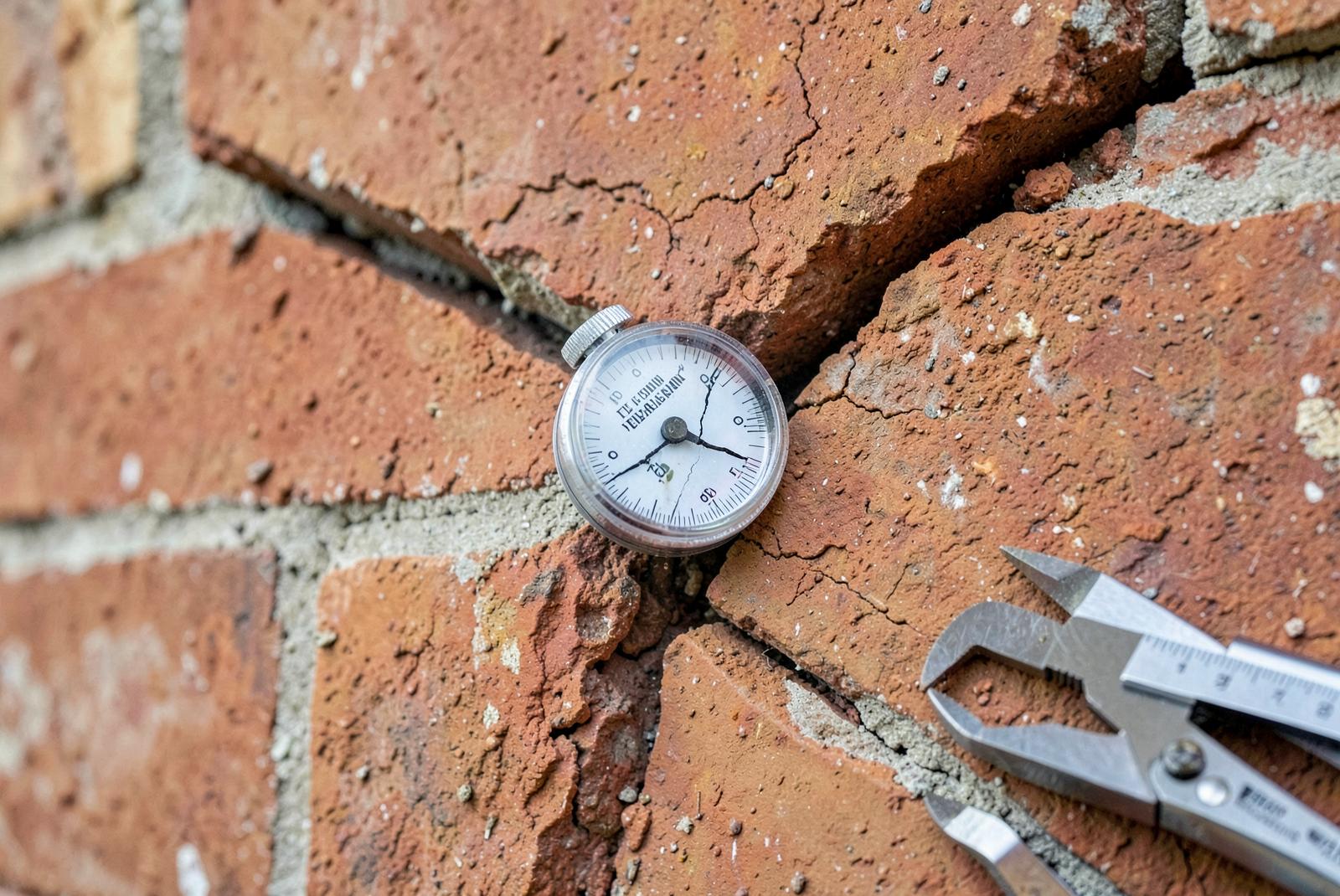
Crack assessment detail

Crack patterns and retrofit options

Start here

  1. 01Is it moving?Monitoring answers this and often changes the recommended response.
  2. 02MechanismReactive, settlement, subsidence and lateral movement need different retrofits.
  3. 03WaterDrainage and leaks are the most common contributing factor and the cheapest to fix.
  4. 04ProportionalityMatch the intervention to the risk and the intended remaining life of the asset.
Crack monitoring gauge fixed across a stepped crack in a brick wall

Comparison

Crack patterns, mechanisms and retrofit options — at a glance

An overview only. Every entry below is described cautiously and is not an engineering limit; suitability is always confirmed against site-specific data.

Comparison of in detail, typical applications and key limitations
In detailBest suited toKey consideration
Shrinkage & Thermal CrackingTypically non-structural, appearing early in the life of the element.Identified by pattern, age and absence of associated distortion or level change.
Reactive Soil (Shrink-Swell) MovementVery common in Queensland clay profiles on residential slabs and footings.Assessed with soil classification, moisture profiling, tree influence and site drainage review.
Differential Settlement CrackingSites with variable profiles, uncontrolled fill or cut-and-fill platforms.Level survey, footing exposure and ground testing to compare actual with assumed founding conditions.
Subsidence & Loss of SupportLeaking services, poorly compacted service trenches, and sites with erodible or dispersive soils.Investigation of services, voids and the erosion path; the leak or flow path must be fixed first.
Lateral & Retaining-Related MovementStructures near retaining walls, batters and sloping ground.Assessed with wall condition, drainage function, slope stability and evidence of ongoing movement.
Crack Mapping & MonitoringAny case where whether movement is continuing changes the remedial decision.Baseline plus repeat readings across at least a seasonal cycle where reactive movement is suspected.
Level & Floor SurveysDistinguishing distortion from cosmetic cracking and locating the movement centre.Compared with distortion limits appropriate to the construction type.
Drainage & Moisture CorrectionThe first and most cost-effective step in most reactive and erosion-related cases.Targets the moisture mechanism identified in the assessment rather than generic landscaping works.
Underpinning & Foundation RetrofitConfirmed inadequate founding conditions or continuing settlement of a defined area.Requires exposure of existing footings, load assessment and staged installation to limit further movement.
Structural Repair InterfaceAll retrofits — geotechnical cause and structural repair must be resolved together.Cause addressed first, then repair sequencing and tolerance for residual movement agreed.

In detail

Crack patterns, mechanisms and retrofit options

Crack width alone is a poor diagnostic. Pattern, location, orientation and whether movement is continuing matter far more.

In detail 01

Shrinkage & Thermal Cracking

Fine, often uniform cracking in concrete, render and masonry from drying shrinkage or temperature change.

Best suited to / typical applications

Typically non-structural, appearing early in the life of the element.

Design & construction considerations

Identified by pattern, age and absence of associated distortion or level change.

Limitations, risks & verification

Can be mistaken for movement cracking; monitoring may be needed to distinguish them.

Discuss this option

In detail 02

Reactive Soil (Shrink-Swell) Movement

Seasonal cyclic movement of expansive clays, often worse near trees, leaks or poor drainage.

Best suited to / typical applications

Very common in Queensland clay profiles on residential slabs and footings.

Design & construction considerations

Assessed with soil classification, moisture profiling, tree influence and site drainage review.

Limitations, risks & verification

Cyclic movement may reopen repairs unless the moisture regime is addressed.

Discuss this option

In detail 03

Differential Settlement Cracking

Tapering diagonal cracking with associated distortion where part of a structure has settled more than the rest.

Best suited to / typical applications

Sites with variable profiles, uncontrolled fill or cut-and-fill platforms.

Design & construction considerations

Level survey, footing exposure and ground testing to compare actual with assumed founding conditions.

Limitations, risks & verification

Requires enough investigation to locate the weaker zone before designing a retrofit.

Discuss this option

In detail 04

Subsidence & Loss of Support

Localised collapse, erosion or washout removing support beneath a footing or slab.

Best suited to / typical applications

Leaking services, poorly compacted service trenches, and sites with erodible or dispersive soils.

Design & construction considerations

Investigation of services, voids and the erosion path; the leak or flow path must be fixed first.

Limitations, risks & verification

Filling voids without stopping the water responsible generally leads to recurrence.

Discuss this option

In detail 06

Crack Mapping & Monitoring

Documented mapping of crack location, width and orientation with gauges or repeat surveys over time.

Best suited to / typical applications

Any case where whether movement is continuing changes the remedial decision.

Design & construction considerations

Baseline plus repeat readings across at least a seasonal cycle where reactive movement is suspected.

Limitations, risks & verification

Takes time; interim measures may be needed on structures with safety concerns.

Discuss this option

In detail 07

Level & Floor Surveys

Relative level survey of floors, footings and wall lines to quantify distortion.

Best suited to / typical applications

Distinguishing distortion from cosmetic cracking and locating the movement centre.

Design & construction considerations

Compared with distortion limits appropriate to the construction type.

Limitations, risks & verification

A single survey gives shape, not direction of travel — repeat surveys establish that.

Discuss this option

In detail 08

Drainage & Moisture Correction

Correcting surface grades, downpipe discharge, subsoil drainage, leaks and vegetation influence.

Best suited to / typical applications

The first and most cost-effective step in most reactive and erosion-related cases.

Design & construction considerations

Targets the moisture mechanism identified in the assessment rather than generic landscaping works.

Limitations, risks & verification

Movement may take seasons to stabilise; structural repair should generally follow, not precede, this work.

Discuss this option

In detail 09

Underpinning & Foundation Retrofit

Extending or supplementing existing foundations using mass concrete, screw piles, micropiles or grouting.

Best suited to / typical applications

Confirmed inadequate founding conditions or continuing settlement of a defined area.

Design & construction considerations

Requires exposure of existing footings, load assessment and staged installation to limit further movement.

Limitations, risks & verification

Partial underpinning can shift the differential elsewhere if the mechanism is misdiagnosed.

Discuss this option

In detail 10

Structural Repair Interface

Coordination with the structural engineer on crack repair, stitching, stiffening and finishes.

Best suited to / typical applications

All retrofits — geotechnical cause and structural repair must be resolved together.

Design & construction considerations

Cause addressed first, then repair sequencing and tolerance for residual movement agreed.

Limitations, risks & verification

Cosmetic repair before the cause is addressed usually recurs.

Discuss this option

Selection considerations

What usually decides the approach

These factors tend to narrow the options faster than any single test result. Every recommendation remains site-specific and subject to the available data.

  • Is it moving?Monitoring answers this and often changes the recommended response.
  • MechanismReactive, settlement, subsidence and lateral movement need different retrofits.
  • WaterDrainage and leaks are the most common contributing factor and the cheapest to fix.
  • ProportionalityMatch the intervention to the risk and the intended remaining life of the asset.
  • CoordinationGeotechnical cause and structural repair should be designed together.

Method

How the work runs

Scope is adjusted to the project, the risk and the information already available.

  1. 01InspectMap cracking, distortion, drainage and construction details.
  2. 02InvestigateLevel survey, footing exposure, soil testing or monitoring as required.
  3. 03InterpretEstablish the mechanism and whether movement is historic or continuing.
  4. 04DesignSet out proportionate remedial and retrofit options with sequencing.

Typical deliverables

  • Crack map, photographic record and level survey results
  • Assessment of mechanism and whether movement is continuing
  • Investigation or monitoring recommendations where cause is unresolved
  • Proportionate retrofit and drainage recommendations with sequencing