Geosynthetics Guide

Geosynthetics explained, product by product

Geosynthetics let you build economically on ground that would otherwise need replacement. This guide explains each product family we specify, its function, applications, selection and design considerations, and the installation and QA controls that decide whether it performs.

Start here

Function first, product second

Reinforcement, separation, filtration, drainage, containment and erosion protection are different functions — and a product that excels at one may be unsuitable for another.

We define the required function and the design properties that go with it (strength at a defined strain, aperture size, permittivity, puncture resistance, UV exposure), then specify products against those properties rather than by brand. Installation detailing — overlaps, seams, anchorage, cover thickness and plant loading — is written into the specification because most geosynthetic failures are installation failures.

  1. 01Required functionDefine reinforcement, separation, filtration, drainage or containment before selecting products.
  2. 02Design propertiesSpecify measurable properties and test standards, not brand names.
  3. 03DurabilityConsider UV exposure, chemical environment, temperature and design life.
  4. 04ConstructabilityRoll widths, overlaps, seaming and plant loading affect achievable quality.
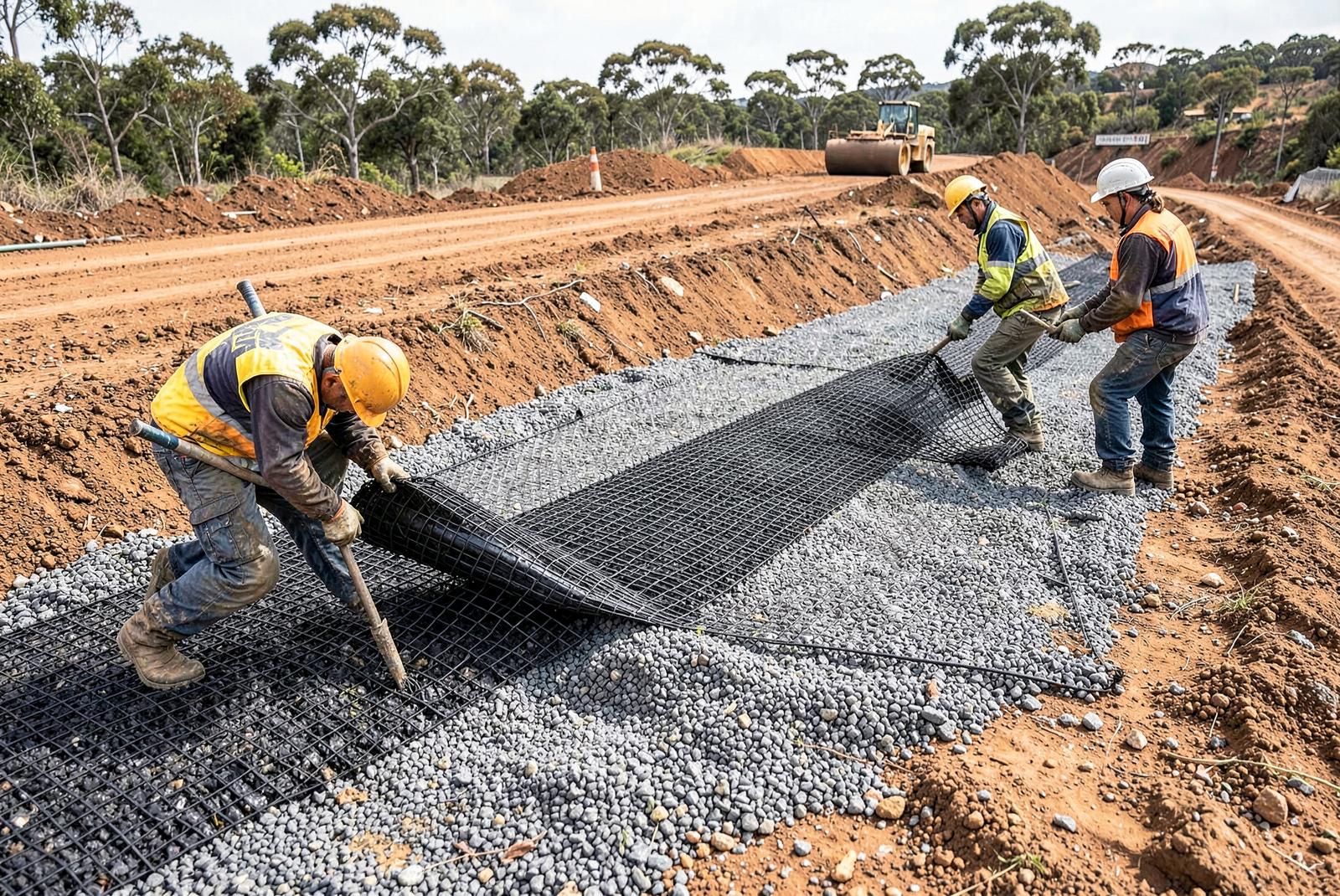
Site crew rolling out polymer geogrid reinforcement over granular fill on a road embankment

Comparison

Products and where each belongs — at a glance

An overview only. Every entry below is described cautiously and is not an engineering limit; suitability is always confirmed against site-specific data.

Comparison of product families, typical applications and key limitations
Product familiesBest suited toKey consideration
GeogridsReinforced fills, steepened slopes, working platforms, subgrade reinforcement and reinforced soil walls.Aperture size matched to aggregate, long-term design strength after reduction factors, spacing and anchorage detailing.
GeotextilesSeparating soft subgrades from granular layers, protecting membranes and filtering drainage.Selected on permittivity, opening size, tensile and puncture properties for the survivability class required.
GeomembranesDams, ponds, tailings and containment cells, and cut-off or lining applications.Thickness, subgrade preparation, welded seam testing, anchor trench and penetration detailing.
Reinforced Soil SystemsHeight changes where conventional walls are impractical, steep batters and bridge or road embankments.Internal and external stability, connection strength, drainage and facing durability designed together.
Separation & FiltrationPavements over soft subgrades, drainage blankets and behind retaining structures.Filter compatibility with the retained soil grading is the controlling selection criterion.
Drainage ApplicationsBehind retaining walls, under pavements, within embankments and in capping layers.Flow capacity assessed at the design confining pressure and gradient, with outlet detailing defined.
Concrete BlanketsChannel and batter lining, scour protection at outlets and structures, and steep drainage paths.Thickness and anchorage set by design flow velocity, with underlying filter layer and edge detailing.

Product families

Products and where each belongs

Product properties vary widely between manufacturers, so design values must come from current product data for the specified product.

Product familie 01

Geogrids

Polymer grids with apertures that interlock with granular fill to provide tensile reinforcement.

Best suited to / typical applications

Reinforced fills, steepened slopes, working platforms, subgrade reinforcement and reinforced soil walls.

Design & construction considerations

Aperture size matched to aggregate, long-term design strength after reduction factors, spacing and anchorage detailing.

Limitations, risks & verification

Requires suitable granular fill and controlled compaction; damage during placement reduces performance.

Discuss this option

Product familie 02

Geotextiles

Woven and non-woven fabrics providing separation, filtration, protection and some reinforcement.

Best suited to / typical applications

Separating soft subgrades from granular layers, protecting membranes and filtering drainage.

Design & construction considerations

Selected on permittivity, opening size, tensile and puncture properties for the survivability class required.

Limitations, risks & verification

Non-wovens have limited stiffness for reinforcement; UV exposure and clogging risk must be managed.

Discuss this option

Product familie 03

Geomembranes

Effectively impermeable sheet liners, commonly HDPE or LLDPE, used for containment.

Best suited to / typical applications

Dams, ponds, tailings and containment cells, and cut-off or lining applications.

Design & construction considerations

Thickness, subgrade preparation, welded seam testing, anchor trench and penetration detailing.

Limitations, risks & verification

Vulnerable to puncture and poor seam quality; requires trained installers and CQA testing.

Discuss this option

Product familie 04

Reinforced Soil Systems

Layered fill and reinforcement forming a composite structure with a wrapped, faced or vegetated face.

Best suited to / typical applications

Height changes where conventional walls are impractical, steep batters and bridge or road embankments.

Design & construction considerations

Internal and external stability, connection strength, drainage and facing durability designed together.

Limitations, risks & verification

Needs adequate space behind the face for reinforcement length and disciplined layer construction.

Discuss this option

Product familie 05

Separation & Filtration

Preventing intermixing of dissimilar layers while allowing water to pass without loss of fines.

Best suited to / typical applications

Pavements over soft subgrades, drainage blankets and behind retaining structures.

Design & construction considerations

Filter compatibility with the retained soil grading is the controlling selection criterion.

Limitations, risks & verification

An incorrectly selected fabric can clog and turn a drainage layer into a water barrier.

Discuss this option

Product familie 06

Drainage Applications

Geocomposite drains, drainage nets and strip drains that collect and convey water within a structure.

Best suited to / typical applications

Behind retaining walls, under pavements, within embankments and in capping layers.

Design & construction considerations

Flow capacity assessed at the design confining pressure and gradient, with outlet detailing defined.

Limitations, risks & verification

Capacity reduces under sustained load and creep; outlets must remain accessible and maintainable.

Discuss this option

Product familie 07

Concrete Blankets

Fabric-formed concrete mattresses and articulated block systems providing hard erosion protection.

Best suited to / typical applications

Channel and batter lining, scour protection at outlets and structures, and steep drainage paths.

Design & construction considerations

Thickness and anchorage set by design flow velocity, with underlying filter layer and edge detailing.

Limitations, risks & verification

Rigid finish with limited vegetation benefit; undermining at edges is the common failure mode.

Discuss this option

Selection considerations

What usually decides the approach

These factors tend to narrow the options faster than any single test result. Every recommendation remains site-specific and subject to the available data.

  • Required functionDefine reinforcement, separation, filtration, drainage or containment before selecting products.
  • Design propertiesSpecify measurable properties and test standards, not brand names.
  • DurabilityConsider UV exposure, chemical environment, temperature and design life.
  • ConstructabilityRoll widths, overlaps, seaming and plant loading affect achievable quality.
  • QASet out inspection, testing and hold points before installation begins.

Method

How the work runs

Scope is adjusted to the project, the risk and the information already available.

  1. 01DefineEstablish the function, loads and design life required.
  2. 02SpecifySet measurable product properties and installation requirements.
  3. 03DetailDesign overlaps, anchorage, drainage outlets and terminations.
  4. 04VerifyInspect installation and confirm conformance before covering.

Typical deliverables

  • Function-based product specification with required properties
  • Design layout, spacing, layer and anchorage details
  • Installation and QA requirements including hold points
  • Construction-phase inspection and conformance reporting

Specifying geosynthetics for a project?

Tell us the application, ground conditions and design life. We will define the function required and specify products against measurable properties.