Landslide Guide

Landslides: mechanisms, assessment and stabilisation

Slope failures need clear answers to three questions: what moved, why it moved and what will stop it. This guide explains the landslide types we assess, how investigation and monitoring establish the mechanism, and the stabilisation options available once it is understood.

Start here

Water is usually the trigger, geology sets the mechanism

Most slope failures in eastern Australia follow rainfall. Understanding the groundwater regime is generally more decisive than any single strength parameter.

We map the movement, establish the depth and shape of the failure surface, and characterise groundwater before selecting remediation. Drainage is often the most cost-effective element of a solution, with regrading and structural support added where geometry or consequence demands it. Risk to people and property is assessed alongside stability so the response is proportionate.

  1. 01MechanismConfirm depth and shape of movement before selecting remediation.
  2. 02ConsequenceRisk to people, dwellings, roads and services sets the required confidence level.
  3. 03WaterPiezometric data usually changes the design more than any other input.
  4. 04AccessPlant access frequently decides between earthworks and structural options.
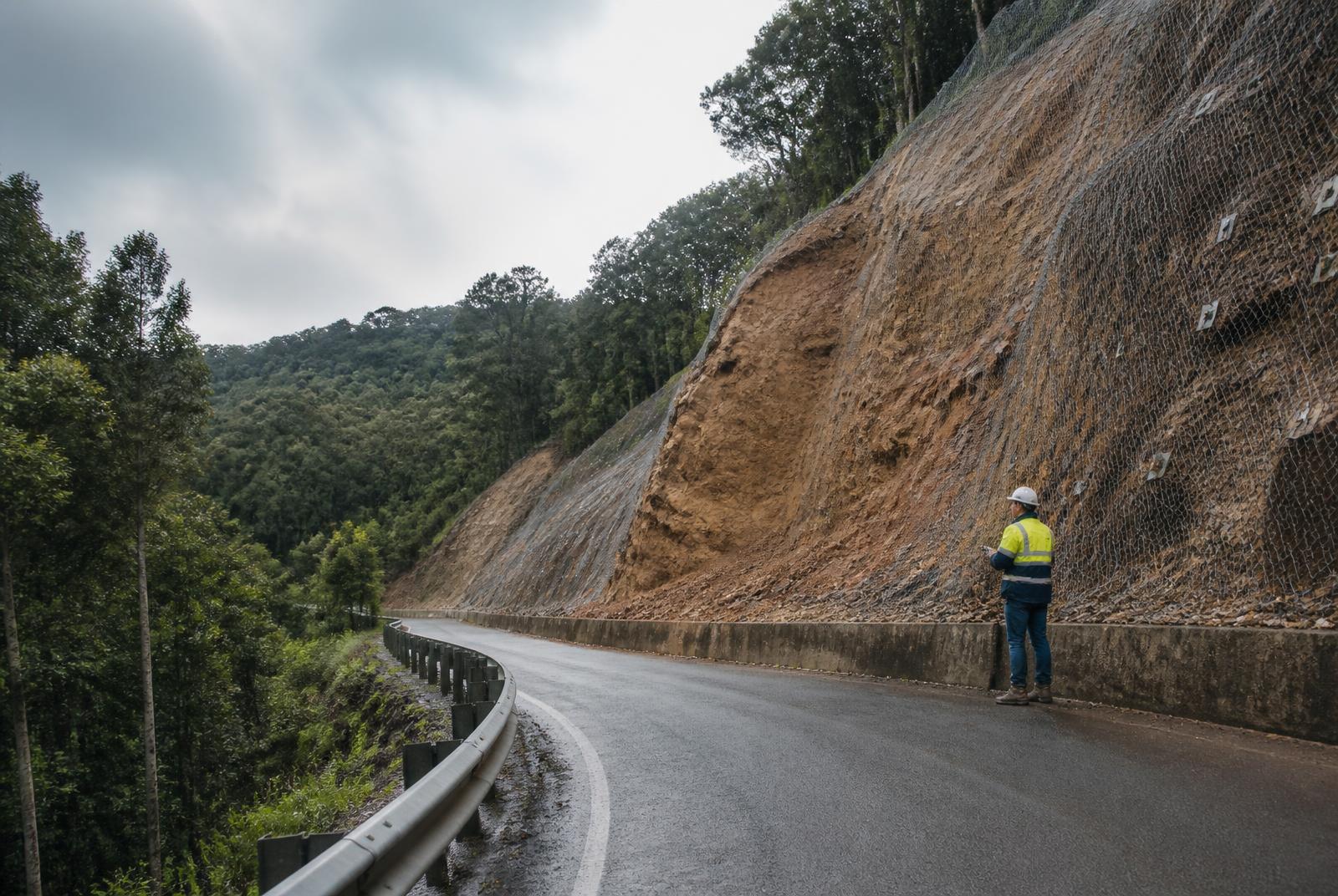
Failed hillside slope showing a slip surface and displaced soil under geotechnical assessment

Comparison

Failure types and stabilisation options — at a glance

An overview only. Every entry below is described cautiously and is not an engineering limit; suitability is always confirmed against site-specific data.

Comparison of mechanisms & responses, typical applications and key limitations
Mechanisms & responsesBest suited toKey consideration
Shallow Slides & Debris FlowsCommonly seen on steep natural slopes, cut batters and fill faces after heavy rain.Assessed with surface mapping, shallow test pits and infiltration behaviour; surface drainage is key.
Rotational & Translational SlidesDeeper failures in clays, weathered profiles and fill embankments.Requires boreholes through the failure surface, piezometers and limit-equilibrium back-analysis.
Rock Slope InstabilityRock cuttings, escarpments and quarried faces.Structural mapping and kinematic analysis, with rock bolts, mesh, catch measures or reprofiling.
Site Investigation for SlopesAny slope where remediation design or risk assessment is required.Investigation must extend below the suspected failure surface, with piezometers installed for water data.
Groundwater AssessmentEvery slope assessment — water pressure typically governs stability more than any other input.Monitoring across a wet season, where programme allows, greatly improves design confidence.
Stability Assessment & RiskDevelopment on or below slopes, and prioritising remediation across multiple sites.Sensitivity analysis on water and strength assumptions is more informative than a single factor of safety.
Slope MonitoringActive or suspected-active slopes, and verification after remediation.Baseline, reading frequency and response triggers agreed before installation.
Drainage RemediationAlmost all slides — frequently the most cost-effective single measure.Designed with the piezometric data; outlets, filters and long-term maintenance access detailed.
Earthworks & RegradingSites with space and access where geometry can be improved directly.Reinforcement or improved fill may be used in reconstruction; staging must maintain stability throughout.
Structural StabilisationConstrained sites, protection of assets and deeper failure surfaces.Elements must extend beyond the failure surface into competent ground; testing and corrosion protection specified.

Mechanisms & responses

Failure types and stabilisation options

Identifying the mechanism first avoids the common error of installing support that does not intersect the actual failure surface.

Mechanisms & response 01

Shallow Slides & Debris Flows

Failure of a thin surficial layer, often colluvium or weathered soil, triggered by intense rainfall.

Best suited to / typical applications

Commonly seen on steep natural slopes, cut batters and fill faces after heavy rain.

Design & construction considerations

Assessed with surface mapping, shallow test pits and infiltration behaviour; surface drainage is key.

Limitations, risks & verification

Can recur seasonally; surface treatments alone will not address any deeper movement present.

Discuss this option

Mechanisms & response 02

Rotational & Translational Slides

Movement on a curved or planar failure surface, often controlled by a weaker layer or a bedding plane.

Best suited to / typical applications

Deeper failures in clays, weathered profiles and fill embankments.

Design & construction considerations

Requires boreholes through the failure surface, piezometers and limit-equilibrium back-analysis.

Limitations, risks & verification

Solutions must intersect the actual surface; shallow measures can be ineffective or counterproductive.

Discuss this option

Mechanisms & response 03

Rock Slope Instability

Block, wedge and toppling failures controlled by discontinuity orientation rather than soil strength.

Best suited to / typical applications

Rock cuttings, escarpments and quarried faces.

Design & construction considerations

Structural mapping and kinematic analysis, with rock bolts, mesh, catch measures or reprofiling.

Limitations, risks & verification

Access and safety constrain mapping; loose material may need controlled removal first.

Discuss this option

Mechanisms & response 04

Site Investigation for Slopes

Boreholes, test pits, mapping and instrumentation targeted at the failure surface and groundwater.

Best suited to / typical applications

Any slope where remediation design or risk assessment is required.

Design & construction considerations

Investigation must extend below the suspected failure surface, with piezometers installed for water data.

Limitations, risks & verification

Access on failed slopes is often difficult; staged investigation may be needed as understanding develops.

Discuss this option

Mechanisms & response 05

Groundwater Assessment

Piezometric monitoring to establish water pressures, perched water and response to rainfall.

Best suited to / typical applications

Every slope assessment — water pressure typically governs stability more than any other input.

Design & construction considerations

Monitoring across a wet season, where programme allows, greatly improves design confidence.

Limitations, risks & verification

Short monitoring periods may miss the critical condition; design must then adopt conservative assumptions.

Discuss this option

Mechanisms & response 06

Stability Assessment & Risk

Limit-equilibrium analysis for short and long-term cases, with likelihood and consequence assessed for people and assets.

Best suited to / typical applications

Development on or below slopes, and prioritising remediation across multiple sites.

Design & construction considerations

Sensitivity analysis on water and strength assumptions is more informative than a single factor of safety.

Limitations, risks & verification

Analysis reflects the assumed geometry and water regime; assumptions must be stated and verified.

Discuss this option

Mechanisms & response 07

Slope Monitoring

Survey points, inclinometers, crack gauges and piezometers to establish whether movement is continuing.

Best suited to / typical applications

Active or suspected-active slopes, and verification after remediation.

Design & construction considerations

Baseline, reading frequency and response triggers agreed before installation.

Limitations, risks & verification

Monitoring measures, it does not stabilise; trigger-action plans are needed for occupied sites.

Discuss this option

Mechanisms & response 08

Drainage Remediation

Surface drainage, cut-off drains, subsurface counterfort or horizontal drains to reduce water pressures.

Best suited to / typical applications

Almost all slides — frequently the most cost-effective single measure.

Design & construction considerations

Designed with the piezometric data; outlets, filters and long-term maintenance access detailed.

Limitations, risks & verification

Effect depends on intercepting the water actually driving movement; drains require maintenance.

Discuss this option

Mechanisms & response 09

Earthworks & Regrading

Unloading the head, buttressing the toe, benching or full reconstruction of the failed mass.

Best suited to / typical applications

Sites with space and access where geometry can be improved directly.

Design & construction considerations

Reinforcement or improved fill may be used in reconstruction; staging must maintain stability throughout.

Limitations, risks & verification

Needs land, access and spoil management; not viable in constrained or built-up locations.

Discuss this option

Mechanisms & response 10

Structural Stabilisation

Soil nails, ground and strand anchors, piles and retaining structures resisting the driving forces.

Best suited to / typical applications

Constrained sites, protection of assets and deeper failure surfaces.

Design & construction considerations

Elements must extend beyond the failure surface into competent ground; testing and corrosion protection specified.

Limitations, risks & verification

Higher cost and specialist plant; ineffective if the failure surface is misidentified.

Discuss this option

Selection considerations

What usually decides the approach

These factors tend to narrow the options faster than any single test result. Every recommendation remains site-specific and subject to the available data.

  • MechanismConfirm depth and shape of movement before selecting remediation.
  • ConsequenceRisk to people, dwellings, roads and services sets the required confidence level.
  • WaterPiezometric data usually changes the design more than any other input.
  • AccessPlant access frequently decides between earthworks and structural options.
  • StagingInterim protection may be needed while investigation and design proceed.

Method

How the work runs

Scope is adjusted to the project, the risk and the information already available.

  1. 01MapRecord movement extent, cracking, seepage and site geometry.
  2. 02InvestigateDrill through the failure surface and install groundwater monitoring.
  3. 03AnalyseBack-analyse the failure and assess remediation options and risk.
  4. 04RemediateDesign, stage and verify the selected stabilisation works.

Typical deliverables

  • Landslide investigation and mechanism assessment
  • Stability analysis and risk assessment
  • Monitoring installation, readings and interpretation
  • Remediation design with staging and verification requirements

Slope movement or a failed batter?

Send photographs, the location and any history of movement or recent rainfall damage. We can advise on interim safety measures and the investigation needed for remediation design.