Site Inspections Guide

Site inspections and engineering advice, explained

A site inspection is only useful if it happens at the right moment and answers a defined question. This guide sets out the inspection types we carry out in Queensland and regional Australia, what is actually looked at, the findings that commonly arise and what you receive afterwards.

Start here

Inspections work best before something is covered up

Most inspection value is lost once footings are poured, fill is placed or a wall is backfilled. Timing the attendance around hold points keeps the cost of a surprise proportionate.

We scope attendance to the risk of the element being inspected: a single visit may be enough for a residential footing, while staged earthworks or a supported excavation usually needs a sequence of visits tied to construction hold points. Where conditions differ from the investigation, we advise on the practical options available at that stage rather than defaulting to the most conservative fix.

  1. 01TimingBook around the hold point, not after it — exposed conditions can be seen only once.
  2. 02DocumentationConfirm whether you need a photographic file note or a signed inspection report for a certifier.
  3. 03Access & safetyExcavations, batters and confined areas need safe access arranged before attendance.
  4. 04Available drawingsApproved plans, the geotechnical report and the earthworks specification make an inspection far more useful.
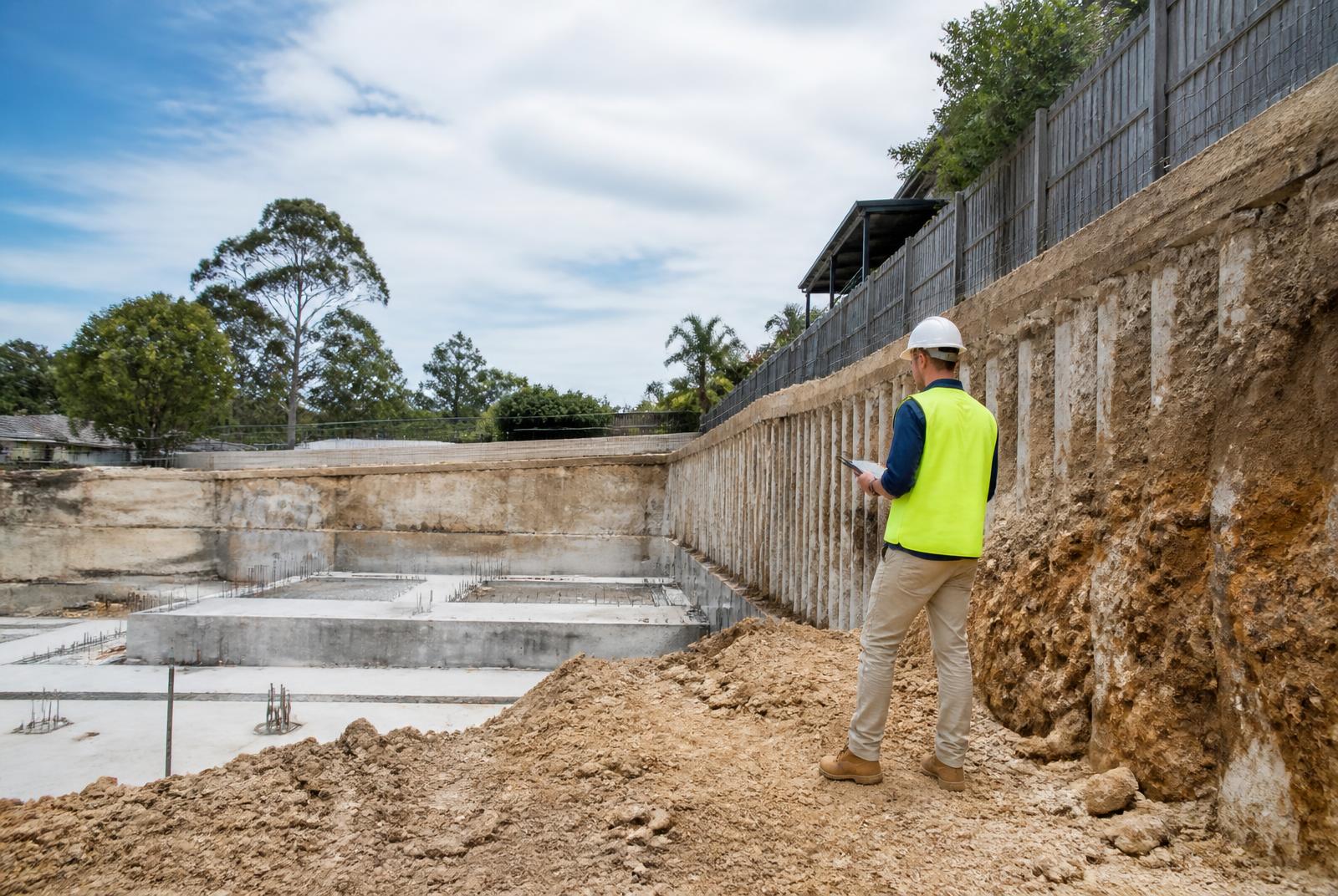
Geotechnical engineer inspecting a strip footing excavation on a residential building site

Comparison

What each inspection covers — at a glance

An overview only. Every entry below is described cautiously and is not an engineering limit; suitability is always confirmed against site-specific data.

Comparison of inspection types, typical applications and key limitations
Inspection typesBest suited toKey consideration
Construction InspectionsProjects where a certifier, developer or owner needs a documented record that ground-related works were built as designed.Attendance is planned around hold points; observations, photographs and any non-conformance are recorded on the day.
Foundation & Excavation InspectionsFooting and pier inspections, basement and trench excavations, and sites where the founding stratum is variable.Founding material is compared with the design assumption; hand or in-situ testing may be used to confirm consistency and strength.
Earthworks & Compaction ReviewBulk earthworks, building platforms, road and pavement subgrades and reinforced fill construction.Reviewed against the earthworks specification, with testing frequency matched to the fill volume and its intended use.
Engineering AdviceBuilders and designers who need a decision quickly without commissioning a full investigation.Advice is framed against the available information and clearly states what remains unverified.
Independent Design ReviewHigh-consequence elements, novel systems, disputed designs or projects where a client wants an impartial check.Review covers the design basis, parameter selection, load cases, drainage, durability and verification requirements.
Site Troubleshooting & Remedial AdviceActive problems where the immediate need is to understand the mechanism and control the risk.Initial site interpretation, interim protection measures, then targeted investigation or monitoring where cause is uncertain.

Inspection types

What each inspection covers

Each inspection type has a different purpose, timing and record. The scope below is indicative and adjusted to the project, the element and the level of risk involved.

Inspection type 01

Construction Inspections

Independent construction-phase observation of earthworks, footings, retaining systems and drainage against the approved drawings and specification.

Best suited to / typical applications

Projects where a certifier, developer or owner needs a documented record that ground-related works were built as designed.

Design & construction considerations

Attendance is planned around hold points; observations, photographs and any non-conformance are recorded on the day.

Limitations, risks & verification

Observation is a sample in time, not continuous supervision — items already covered cannot be verified without exposure.

Discuss this option

Inspection type 02

Foundation & Excavation Inspections

Review of founding material, excavation stability, batter condition, water ingress and any temporary support before concrete or backfill.

Best suited to / typical applications

Footing and pier inspections, basement and trench excavations, and sites where the founding stratum is variable.

Design & construction considerations

Founding material is compared with the design assumption; hand or in-situ testing may be used to confirm consistency and strength.

Limitations, risks & verification

Deeper or seepage-affected conditions may need additional testing before founding depth can be confirmed.

Discuss this option

Inspection type 03

Earthworks & Compaction Review

Field review of fill material, layer thickness, moisture conditioning, compaction effort and density verification through the filling programme.

Best suited to / typical applications

Bulk earthworks, building platforms, road and pavement subgrades and reinforced fill construction.

Design & construction considerations

Reviewed against the earthworks specification, with testing frequency matched to the fill volume and its intended use.

Limitations, risks & verification

Density testing verifies tested locations only; a poor result usually means reworking that layer before the next is placed.

Discuss this option

Inspection type 04

Engineering Advice

Practical geotechnical guidance in response to unexpected ground conditions, a design query or a constructability problem raised on site.

Best suited to / typical applications

Builders and designers who need a decision quickly without commissioning a full investigation.

Design & construction considerations

Advice is framed against the available information and clearly states what remains unverified.

Limitations, risks & verification

Verbal or interim advice is provisional; where the risk is material we recommend confirming it with testing or a written report.

Discuss this option

Inspection type 05

Independent Design Review

Second-party review of geotechnical reports, designs and specifications for completeness, risk, assumptions and constructability.

Best suited to / typical applications

High-consequence elements, novel systems, disputed designs or projects where a client wants an impartial check.

Design & construction considerations

Review covers the design basis, parameter selection, load cases, drainage, durability and verification requirements.

Limitations, risks & verification

A review comments on the documentation provided and does not transfer design responsibility for another party's work.

Discuss this option

Inspection type 06

Site Troubleshooting & Remedial Advice

Rapid diagnosis of cracking, settlement, seepage, slumping or instability, with proportionate options for the next step.

Best suited to / typical applications

Active problems where the immediate need is to understand the mechanism and control the risk.

Design & construction considerations

Initial site interpretation, interim protection measures, then targeted investigation or monitoring where cause is uncertain.

Limitations, risks & verification

First attendance often narrows rather than confirms the cause; a remedial design may still require investigation data.

Discuss this option

Selection considerations

What usually decides the approach

These factors tend to narrow the options faster than any single test result. Every recommendation remains site-specific and subject to the available data.

  • TimingBook around the hold point, not after it — exposed conditions can be seen only once.
  • DocumentationConfirm whether you need a photographic file note or a signed inspection report for a certifier.
  • Access & safetyExcavations, batters and confined areas need safe access arranged before attendance.
  • Available drawingsApproved plans, the geotechnical report and the earthworks specification make an inspection far more useful.
  • FrequencyStaged works usually need a planned inspection sequence rather than a single visit.

Method

How the work runs

Scope is adjusted to the project, the risk and the information already available.

  1. 01BriefAgree the element, the question to be answered and the hold point the visit is tied to.
  2. 02AttendInspect, test where appropriate, photograph and record the conditions found.
  3. 03InterpretCompare observations with the design intent and identify any non-conformance or residual risk.
  4. 04ReportIssue a file note or inspection report with clear findings and, where needed, the next action.

Typical deliverables

  • Inspection report or documented site file note
  • Photographic record of conditions observed
  • Statement of conformance or non-conformance against the design intent
  • Practical recommendations and any further testing required

Need an inspection or a second opinion on site?

Tell us the site location, the element to be inspected and the date it will be exposed. We will confirm an appropriate attendance and reporting scope.